
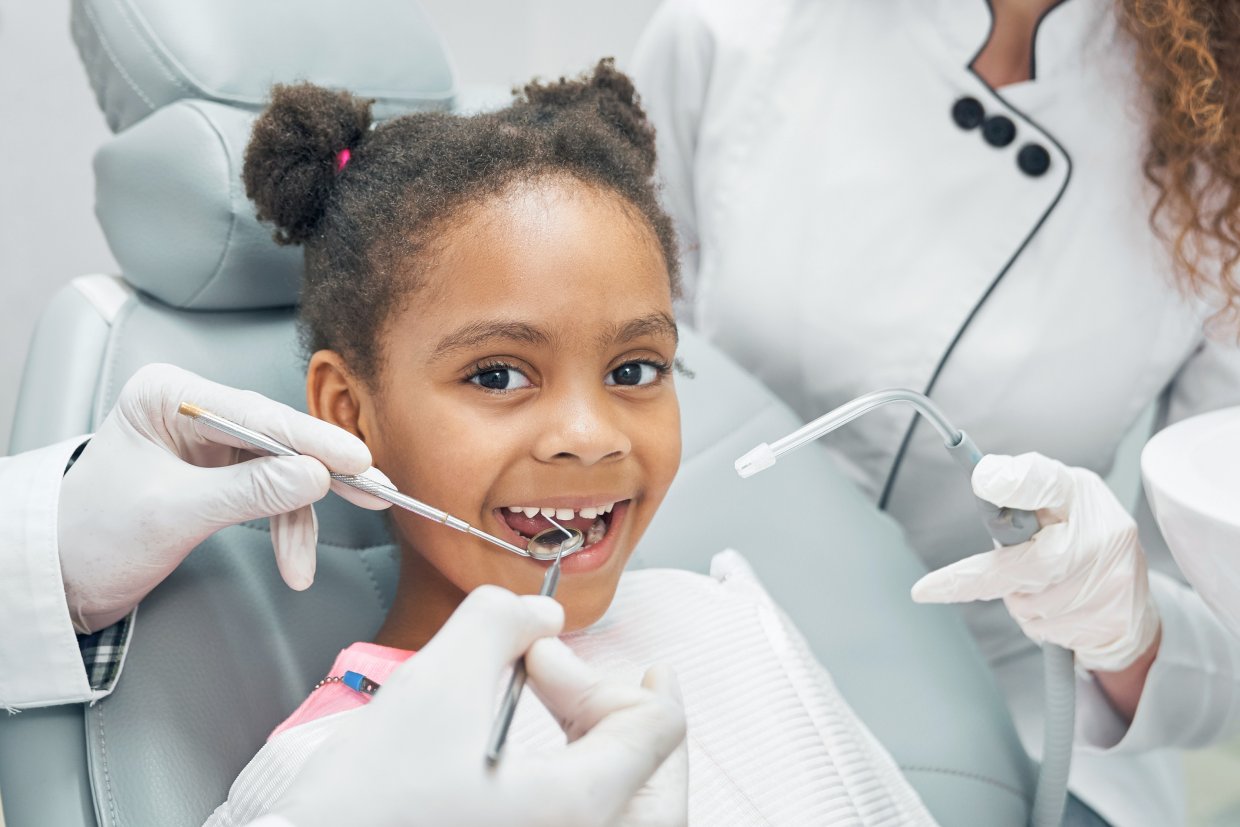
Most children start losing baby teeth around age 6, though anywhere from age 4 to 7 is considered normal. The lower front teeth usually go first, followed by the upper front teeth, then side teeth, canines, and molars. All 20 baby teeth are typically gone by age 12 or 13.
Every child is a little different, and timing often runs in families. If you lost your first tooth early, your child might too. Girls tend to lose teeth slightly earlier than boys, though the difference is usually small. Late bloomers are perfectly common, and early losers are too.
At Fairhope Children’s Dentistry, this stage is a great time to build lifelong dental habits. Our team watches for healthy patterns during regular visits and answers the many questions parents have as those wiggly teeth start showing up. If you’re wondering whether your child’s timing is on track, a quick exam can put your mind at ease.
How Do Baby Teeth Fall Out? The Natural Process
Baby teeth fall out through a process called root resorption, where the permanent tooth underneath slowly pushes upward and dissolves the roots of the baby tooth above it. As the roots shrink, the baby tooth loosens and eventually falls out on its own, usually with a bit of wiggling from your child. A new permanent tooth typically appears within a few weeks to a few months.
Here’s what usually happens, step by step:
- The permanent tooth begins pressing upward against the roots of the baby tooth above it.
- Root resorption slowly dissolves those roots, weakening the baby tooth’s grip.
- The tooth becomes wiggly and your child may notice it moving during eating or brushing.
- The baby tooth falls out naturally, often during a meal or while your child is playing with it.
- The permanent tooth erupts into the empty space, usually within weeks to a few months.
We encourage families to let loose teeth wiggle out on their own rather than pulling them early. Pulling a tooth before it’s ready can lead to infection or unnecessary bleeding. It’s tempting, we know. Still, patience wins here. A little bleeding after a tooth falls out is completely normal. A gentle rinse with warm salt water and a soft piece of gauze pressed on the spot for a minute or two usually does the trick.
What Order Do Baby Teeth Fall Out?
Baby teeth usually fall out in roughly the same order they came in, starting with the bottom front teeth and working outward and backward. This natural sequence gives permanent teeth room to erupt in a healthy pattern.
Here’s the typical order and age range for losing each type of baby tooth:
| Baby Tooth | Typical Age of Loss |
|---|---|
| Lower central incisors (bottom front) | 6 to 7 years |
| Upper central incisors (top front) | 6 to 7 years |
| Upper lateral incisors | 7 to 8 years |
| Lower lateral incisors | 7 to 8 years |
| Lower canines | 9 to 12 years |
| Upper first molars | 9 to 11 years |
| Lower first molars | 9 to 11 years |
| Upper canines | 10 to 12 years |
| Second molars (upper and lower) | 10 to 12 years |
The two bottom front teeth are almost always the first to go, which is why so many first-grade photos feature that classic gap-toothed grin. From there, the upper front teeth follow, then the side incisors, and eventually the canines (the pointed teeth) and molars (the flat back teeth) round things out. Families we see at Fairhope Children’s Dentistry often notice this pattern unfold right on schedule.
If your child’s teeth are coming out in a slightly different order, that’s usually nothing to worry about. Small variations are common and often follow family patterns. Regular visits help us confirm that everything is progressing the way it should.
Why Does the Natural Loss of Baby Teeth Matter?
Baby teeth do far more than fill in a cute smile. They act as placeholders for permanent teeth, guiding them into proper alignment as they erupt. When baby teeth fall out on their natural schedule, it usually signals that jaw growth and dental development are moving along nicely.
Here’s why timing matters:
- Alignment guidance. Baby teeth hold space and direct permanent teeth into the correct position.
- Jaw development. Chewing with healthy baby teeth supports proper jaw growth and muscle strength.
- Speech clarity. Front teeth play a role in forming certain sounds during the toddler and early school years.
- Confident eating. Children need those back teeth to chew a full range of foods, which supports nutrition.
- Fewer future concerns. On-time loss reduces the need for space maintainers or early orthodontic care.
When a baby tooth falls out too soon or stays in too long, the surrounding teeth can shift, which sometimes creates crowding for the permanent teeth waiting underneath. That’s one reason we monitor tooth loss carefully during regular visits.
Losing Teeth Naturally vs. Early Loss From Decay or Injury
Not every lost tooth is a moment worth celebrating. Sometimes teeth come out earlier than they should, and the reason matters. Here’s how natural loss compares to early loss from decay or injury:
| Factor | Natural Loss | Early Loss (Decay or Injury) |
|---|---|---|
| Timing | Ages 6 to 12, in typical order | Before age 4, or well before the permanent tooth is ready |
| Cause | Permanent tooth pushing up, root resorption | Cavities, trauma, or accidents |
| Signs | Wiggly tooth, no discomfort, permanent tooth visible | Sudden loss, damaged tooth, or infection |
| What Happens Next | Permanent tooth erupts within weeks or months | Neighboring teeth may shift into the empty space |
| Intervention Needed | Usually none | Often a space maintainer to hold the spot |
When a baby tooth is lost too early, the teeth on either side can drift into the empty space, leaving less room for the permanent tooth to come in properly. In these cases, a small dental appliance called a space maintainer can preserve the gap until the permanent tooth is ready to erupt.
If your child loses a baby tooth before age 4, or if a tooth is knocked out due to a fall or sports injury, we recommend scheduling a visit with our team right away. A quick exam helps us decide whether a space maintainer or other supportive care is needed to protect your child’s growing smile.
What Affects When Your Child Loses Teeth?
Timing varies quite a bit from child to child, and several factors influence when those wiggly teeth start showing up. Genetics is the biggest one. If you or your partner lost teeth early or late, your child will likely follow a similar pattern.
Other factors that can affect timing include:
- Nutrition and overall health. Balanced meals support strong tooth development from the start.
- Eruption timing. Children whose baby teeth came in early often lose them earlier, and the same is true for late eruptors.
- Tooth decay. Cavities can weaken baby teeth and lead to earlier loss, or in some cases, delay the natural process.
- Trauma or injury. A fall or sports impact can knock a tooth out before its time.
- Gender. Girls often lose teeth slightly earlier than boys, though the difference is usually minor.
Because so many factors are at play, there’s a wide window of what’s normal. That said, patterns matter. If your child’s timing seems off compared to siblings or classmates, a quick exam can help us figure out if anything needs attention. Our team at Fairhope Children’s Dentistry is always glad to take a look.
When Should Children See a Pediatric Dentist About Tooth Loss?
Most tooth loss happens smoothly at home with no need for a special visit. Still, some situations do warrant a call to our team. Regular visits every six months allow us to monitor healthy development and catch anything unusual early.
Here’s when to schedule a visit:
- First tooth lost before age 4 or after age 8. Timing outside this range deserves a closer look.
- A permanent tooth erupting behind a baby tooth. Sometimes called “shark teeth,” this happens when the baby tooth hasn’t fallen out yet and the permanent tooth comes in behind it.
- No permanent tooth appearing months after loss. If the space stays empty for a long time, we may want to check with a digital X-ray.
- Persistent bleeding, swelling, or discomfort. These signs can point to infection or another concern that needs care.
- A tooth knocked out from injury. Trauma requires a same-day evaluation whenever possible.
Our team helps families through the tooth-loss years. Dr. Elizabeth Clay (DDS), Dr. Katherine Rodriguez-Feo (DMD, Pediatric Dentistry), and Dr. Kelly Jones (DMD) bring years of specialized training in caring for growing smiles, and every visit is designed to keep your child comfortable and confident.
If you have questions about your child’s tooth-loss timeline, or if you’d like to schedule a visit with our team, we’d love to see you. Regular checkups are the best way to make sure your child’s smile is growing right on track, and we’re always happy to answer the small questions that come up along the way.
Frequently Asked Questions
At what age do children lose their first baby tooth?
Most children lose their first baby tooth around age 6, though anywhere from age 4 to 7 is considered normal. The two lower front teeth are almost always the first to go. If your child loses a tooth much earlier or later than this window, a quick exam can confirm that everything is developing as expected.
What order do baby teeth fall out in?
Baby teeth usually fall out in roughly the same order they came in. The lower central incisors go first, followed by the upper central incisors, the lateral incisors, the canines, and finally the molars. This sequence helps guide the permanent teeth into proper alignment as they erupt.
Should I pull my child’s loose baby tooth?
We encourage families to let loose teeth wiggle out on their own rather than pulling them early. Pulling a tooth before it’s ready can lead to infection or unnecessary bleeding. If a tooth stays loose for a very long time or seems to be causing discomfort, give our team a call and we can take a look.
What are “shark teeth” and are they a concern?
“Shark teeth” happen when a permanent tooth erupts behind a baby tooth that hasn’t fallen out yet, creating a double row. This is fairly common and often resolves on its own as the baby tooth loosens. If the baby tooth doesn’t come out within a few weeks, schedule a visit so we can check whether it needs a little help.
When should I be concerned about my child’s tooth loss?
Reach out if the first tooth is lost before age 4 or after age 8, if a permanent tooth is delayed for months after a baby tooth falls out, or if there is persistent bleeding, swelling, or discomfort. Any tooth knocked out from an injury deserves a same-day evaluation whenever possible. Regular six-month visits also help us catch anything unusual early.